
Making the Most of Your Garage Ceiling
If you live in Arizona, you already know your garage has to do a lot of work.
We generally don’t have basements, and attic space can be limited. So homeowners naturally start looking at every available square foot—including the ceiling.
And that’s not a bad idea.
Ceiling storage can be an incredibly useful part of a well-designed garage.
But there’s a right way and a wrong way to use it.
The biggest mistake I see is assuming that because there’s empty space above your head, that’s automatically the best place to put your stuff.
It isn’t.
Ceiling Storage Should Be Plan B
I generally don’t consider overhead storage the primary storage solution.
It’s Plan B.
I want to use the walls first whenever possible.
Why?
Accessibility.
A wall shelf that’s 24 inches deep is pretty easy to reach. You walk up, grab what you need, and walk away.
An overhead rack is different.
Most are approximately 4 feet by 8 feet. And unless you’re an NBA star, you probably don’t have four-foot-long arms.
I’ve seen people climb onto things they shouldn’t, or use broom handles and yard tools to push boxes and totes toward the edge.
That’s not how I want somebody using their garage.
So I start with the walls and the things that need to be easily accessible. Once we’ve taken advantage of that space, then we look up and ask:
“What makes sense to put overhead?”
That’s where ceiling storage shines.
Sometimes the Best Thing to Store Overhead Isn’t a Box
When most people hear “overhead storage,” they think about plastic totes full of Christmas decorations.
Those are great candidates.
But some of the best things to put overhead aren’t boxes at all.
They’re the big, awkward things that are useful—but only occasionally.
Bicycles.
Kayaks.
Canoes.
Rooftop cargo carriers.
Rooftop tents.
Generators.
Fifth-wheel hitches.
And here in Arizona, Jeep and Bronco hard tops.
If you’ve got a Jeep or Bronco, you know what I’m talking about. We live in Arizona. People love their Jeeps and Broncos, and with all this sunshine, they love to go topless.
Pun absolutely intended.
But where do you put that giant hard top when it’s sitting in your garage?
You don’t want it leaning against the wall. You don’t want it taking up half the floor. And you certainly don’t want your kids riding their bikes into it.
This is where motorized lifting systems become really interesting.
We can use the same basic technology to get large, awkward items up and out of the way. When you’re ready to go camping, kayaking, or put the top back on your Jeep, bring it back down.
In some cases, you can even lower it directly into the bed of your truck.
You’re not just storing stuff. You’re reclaiming floor space.
Our standard lifters can handle up to 400 pounds and ceilings up to 12 feet. We also have systems capable of lifting up to 600 pounds and working with ceilings as high as 18 feet.
So when somebody tells me, “I don’t have anywhere to put my kayak,” sometimes I just look up and say:
“Why don’t we put it up there?”
Not All Ceiling Storage Is Created Equal
There are two basic types of overhead storage: fixed racks and motorized racks.
Fixed racks are simple. They’re mounted to the ceiling, don’t require electricity, and cost less.
They absolutely have their place.
But accessibility and weight are two reasons they aren’t always my first choice.
People often ask me, “How much can I put up there?”
The honest answer is:
“I don’t know.”
The steel rack itself isn’t generally the weak point. The variables are the condition of the trusses, how the rack is attached, and the hardware being used.
We typically consider somewhere around 500 to 600 pounds to be a safe range, but I can’t guarantee that every ceiling and every set of trusses will safely handle a particular load.
That’s one reason I use high-quality structural lag screws with extremely high holding and tensile strength.
And remember, two racks in a typical two-car garage could mean 1,000 to 1,200 pounds hanging from the trusses.
That’s a lot of weight.
Compare that with Monkey Bar shelving, which is attached directly to wall studs and engineered to distribute weight in that vertical configuration.
That’s a very different situation from hanging hundreds of pounds from the bottom of a roof truss.
And Then There’s the Motorized Option
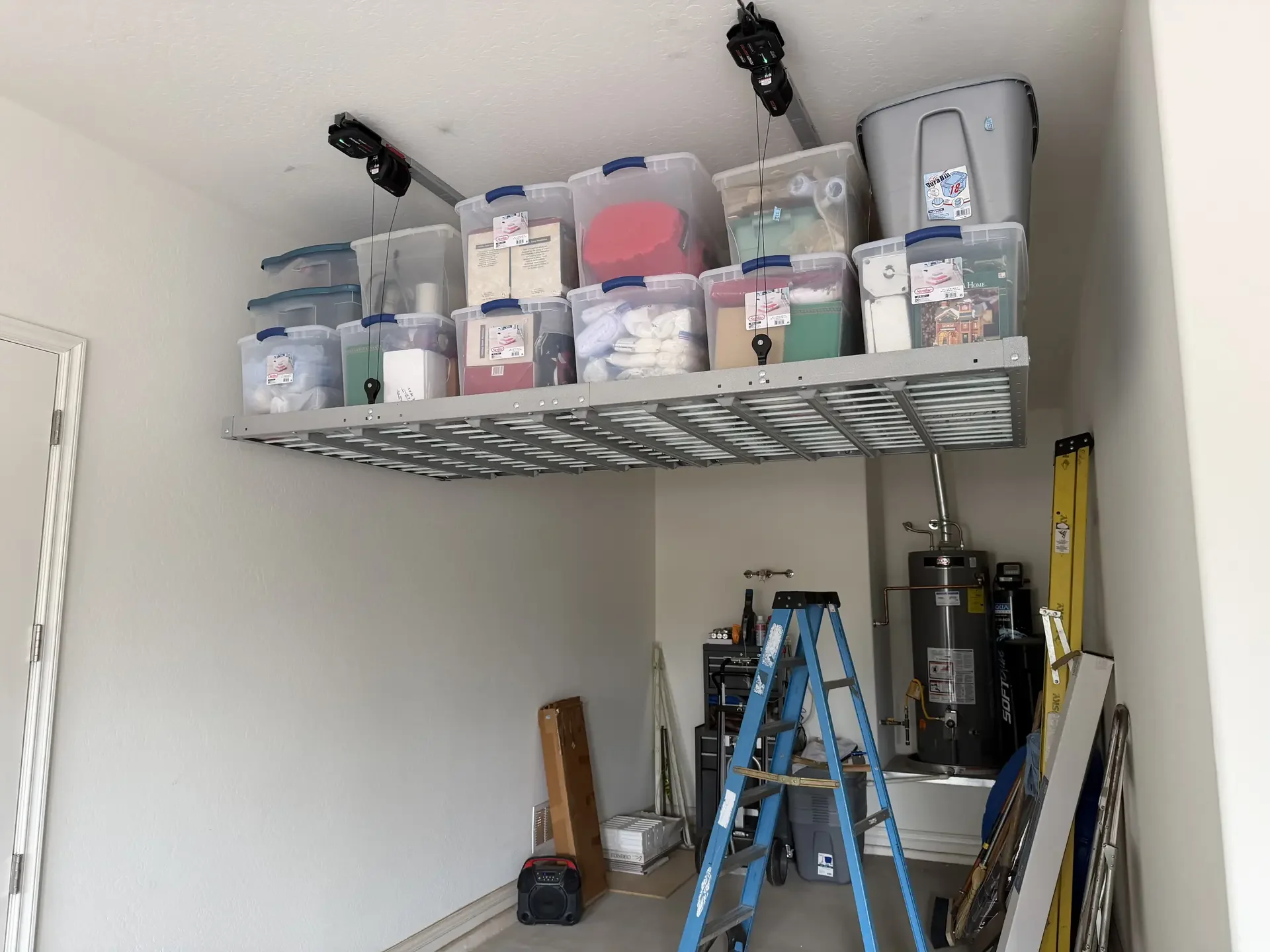
Motorized racks are incredibly user-friendly.
They operate through an app on your phone, and you can program preset positions so the rack stops at exactly the same place every time.
They also have automatic load limiters, so you don’t accidentally overload the system.
And they’re just easy to use.
Even people who aren’t comfortable with technology can operate them with ease because the controls are intuitive.
There’s also a legitimate accessibility benefit.
I’ve had customers who simply shouldn’t be climbing ladders. Maybe they’re older, have balance issues, or are taking blood thinners.
For those people, a motorized system can be a fantastic solution because:
The storage comes down to them.
And Sometimes You Just Want the Coolest Thing
I’ll be honest.
Some people just like nice stuff.
They have the money. They want the coolest things around. They want their garage to be impressive.
And there’s nothing wrong with being a little bougie.
Motorized lifts are perfect for that.
They’re convenient. They’re impressive. They look cool.
Not every garage decision has to be justified by a spreadsheet.
Sometimes you just want the cool stuff.
I’m okay with that.
But There Is One Little Catch
Motorized racks require electricity.
So if the power goes out, you’re going to have to postpone decorating for Easter until the power comes back on.
Unless you want to break out a ladder and get the stuff the old-fashioned way.
That’s the reality.
The good news is that the motors have a redundant mechanical safety lock. If the power goes out or the motor stops working properly, the system doesn’t simply free-spool and drop.
Think about a mechanic’s car lift. There’s a mechanical safety lock that prevents the vehicle from falling if the motor fails.
It’s the same basic idea here.
And I’ve actually had one fail.
Since we started installing these systems in 2012, I’ve only had one motor stop functioning properly. It wasn’t a mechanical failure. I believe a solder connection inside the electronics broke, causing the motor to lose its Bluetooth connection.
The customer called me.
I was there the next day, replaced the motor, and he was back up and running within 48 hours.
Period.
No service fee. No labor fee. No parts fee.
We stand behind our products and offer unlimited lifetime warranties because they’re truly that solid.
Since 2012, that’s the only motor I’ve ever had to deal with.
Period.
What Should You Put Up There?
This is where the frequency of use becomes important.
The things that belong overhead are generally the things you rarely need.
Your wife’s wedding dress.
Keepsakes from Grandma.
Your daughter’s box of accomplishments from grade school.
Tax records from 1982.
You want to keep these things, but you don’t need to get into them every Tuesday afternoon.
That’s exactly what overhead storage is good for.
Seasonal decorations are another great example.
Christmas.
Halloween.
Easter.
You might cuss and complain while you’re getting them down once a year, but you’ve got another eleven months to get over it.
That’s a pretty good trade.
And remember, not everything that belongs overhead needs to sit on a rack.
A kayak doesn’t need a 4×8 storage rack.
Neither does a Jeep hard top.
Those items can be suspended individually and brought back down when you need them.
That’s what makes the ceiling such valuable real estate.
Don’t Turn It Into a Junk Pile
Here’s where I’ve seen people take a good storage system and make it work poorly.
They throw random-sized objects up there.
A box here.
A cooler there.
A couple of loose bags.
Something shoved into the corner.
Pretty soon, you’ve created a giant, cluttered pile six feet in the air.
And you’ve made an already-inconvenient storage system even harder to use.
Symmetry matters.
I like using uniform storage totes that fit both the rack and the things you’re storing.
For example, a 72-quart Hefty clear storage tote can fit five down one side and five down the other—ten totes per layer.
Depending on rack height, you can have a single or double layer.
That’s ten or twenty totes on one rack.
A 66-quart Sterilite tote can fit six down each side—twelve per layer.
The big 27-gallon Home Depot/Costco-style totes only fit about seven on a layer, so they’re not the most efficient use of that space in my opinion.
The point isn’t that everyone needs to buy the exact totes I use.
The point is to think about the storage system as a system.
Don’t Forget to Label the Stuff
Some people like clear totes because they can see what’s inside from the ground.
Personally, I think that can make the garage look more cluttered because, well…
I can see everything that’s in them.
Other people use themed stickers:
Halloween.
Christmas.
Easter.
Others use simple labels:
- Camping Gear
- School Stuff
- Baby Clothes — 6–12 Months
And then there are the people who get really fancy.
I’ve had customers use QR codes. They stick a QR code on each tote, scan it from the ground with their phone, and pull up an itemized inventory of what’s inside.
That’s probably more technology than most people need.
But I have to admit…
It’s pretty cool.
What Shouldn’t Go Up There?
The floor of these racks isn’t solid. It has large openings in the grid.
So small items aren’t appropriate for overhead storage because they can fall through.
Only larger items that comfortably span those openings should go overhead.
I’m also careful about liquids.
I would never put pool chemicals, automotive chemicals, or cleaning supplies directly on a ceiling rack unless they’re separately stored inside a liquid-tight plastic tote.
The last thing you want is something leaking six feet above your vehicle.
I’ve even had customers use carpeting and plywood to create a more solid floor so smaller items won’t fall through.
Again, it’s about understanding what the system is designed to do and using it appropriately.
Give Yourself Room to Access It
When we install ceiling racks, I try not to put them directly against a wall or in a corner.
Whenever possible, I leave enough room around all four sides so a ladder can be positioned on any side.
If you’re using uniform storage totes, you can approach them from any side and easily reach what you need.
And there’s one thing I will absolutely never encourage:
Don’t crawl out onto the rack.
It’s a storage rack.
It’s not a second floor.
If you have to climb out onto the rack to get something, you’ve already designed or loaded the system incorrectly.
One More Thing If Your House Is New
If you’ve just built or bought a new home, there’s one thing I strongly recommend before installing ceiling storage:
Call your home builder.
A lot of builders here in the East Valley will void their new-home truss warranty if you install ceiling racks during the first year.
Arizona builders are required to come back around the one-year mark and address things like drywall cracks, nail pops, tape and texture issues, and other problems associated with the house settling.
Here’s the problem with putting weight on the bottom of your roof trusses.
The trusses were designed primarily to carry the weight of the roof pushing down from above. They weren’t necessarily designed for you to hang hundreds of pounds from the bottom chord.
That doesn’t mean the truss is going to fail.
But it can create some flex, which can contribute to cosmetic drywall cracking at seams or in the texture.
Then you’ve got a homeowner saying, “The builder needs to fix this,” and the builder saying, “You installed those ceiling racks.”
Now you’re arguing about whether the cracks were caused by normal settling or the additional weight.
So my advice is simple:
Ask first.
Call your builder and ask whether ceiling storage will affect your warranty.
If they say it’s fine, great.
If they say no, wait until the warranty period has passed or choose another storage solution.
Either way, it’s better to know before you drill the first hole.
Three Things I Want You to Remember
If you forget everything else I said about overhead storage, remember these three things.
1. Make the ceiling Plan B.
Use your walls and other accessible storage first. The ceiling is fantastic backup storage, but it shouldn’t automatically be your primary storage solution.
2. Don’t turn it into a junk pile.
Use uniform totes that fit the rack and the things you’re storing. Keep things organized, symmetrical, and easy to identify.
And remember that large, awkward items don’t necessarily need a rack at all. A motorized lifting system can get bikes, kayaks, hard tops, rooftop tents, generators, and other bulky items safely up and out of the way.
3. If your house is new, call the builder first.
Find out whether installing ceiling storage will affect your truss warranty before you put anything up there.
Ryan’s Bottom Line
Ceiling storage is a fantastic tool. I sell it. I install it. I like it.
But I don’t believe it belongs in every garage, and I don’t believe it should automatically be the first storage solution we reach for.
Use your walls first.
Put the things you use regularly somewhere you can easily reach them. Then look up.
That’s where the Christmas decorations, old tax records, keepsakes, wedding dresses, kayaks, bikes, rooftop tents, generators, Jeep hard tops, and all of those other big, awkward things you want to keep but don’t need every day can live.
If you’re going to use an overhead rack, use it intentionally. Choose storage containers that fit the space. Keep things organized and symmetrical. Label them so you know what’s up there. Don’t put small or hazardous items directly on the open rack. Leave yourself room to access everything safely.
And if you’re considering a motorized lift, understand what you’re paying for.
You’re paying for convenience.
You’re paying for accessibility.
You’re paying for the ability to get large, awkward things off your garage floor and out of harm’s way.
You’re paying for a system that can bring the storage down to you instead of requiring you to climb up to it.
And, yes…
You’re also paying to have the coolest garage on the block.
There’s nothing wrong with that either.
Just remember: the goal isn’t to fill every available inch of your garage with stuff.
The goal is to make your garage work better.
Sometimes the best way to do that is to look up.
That’s my bottom line.