
A Quick Note From Ryan
When the garage door opens for the first time, I start looking.
I look at what’s on the floor.
I look at what’s hanging on the walls.
I look up toward the ceiling.
I notice bicycles. Camping equipment. Sports equipment. Tools. Christmas decorations. Coolers. Boxes. Maybe a home gym. Maybe a workbench. Maybe Dad is into cars. Maybe the family spends every weekend outdoors.
I look for the big, awkward things too.
A rooftop cargo carrier.
A paddleboard.
A kayak.
A Jeep hard top.
A receiver-hitch bike rack.
A generator.
A fifth-wheel hitch.
Those things tell me a lot about how a family uses its garage.
But there’s something I do before I start thinking about any of that.
I introduce myself.
I thank them for inviting me into their home.
And then I ask:
“What are you trying to accomplish?”
That question is where the real conversation begins.
I Don’t Want to Tell You What You Need
I’ve always thought there was something backwards about the way some people sell garage storage.
A salesman walks into a garage, looks around for thirty seconds, and starts telling the homeowner what they need.
“You need cabinets here.”
“You need shelving there.”
“You need this many feet of storage.”
Maybe they’re right.
But how do they know?
They haven’t asked the homeowner why they called.
They haven’t asked what’s bothering them.
They haven’t asked what they want the garage to become.
I don’t want to be that guy.
Something has obviously happened to make you willing to spend your hard-earned money on your garage. Maybe you’re tired of parking your vehicles outside. Maybe you can’t find anything anymore. Maybe you’re tired of climbing over boxes. Maybe you’ve bought a new car and suddenly realized there’s nowhere to put all the stuff that was already in the garage.
Whatever the reason is, I want to hear it from you.
Because once I understand the why, I can have a much better conversation about the how.
The Product Isn’t Always the Answer
A homeowner might tell me, “I want cabinets down this wall.”
My next question might surprise them.
“Why cabinets?”
Sometimes they have a very good reason.
Other times, the answer is simply:
“Because that’s what I’ve always seen in garages.”
And that’s where I start explaining that there are a lot more options than most people realize.
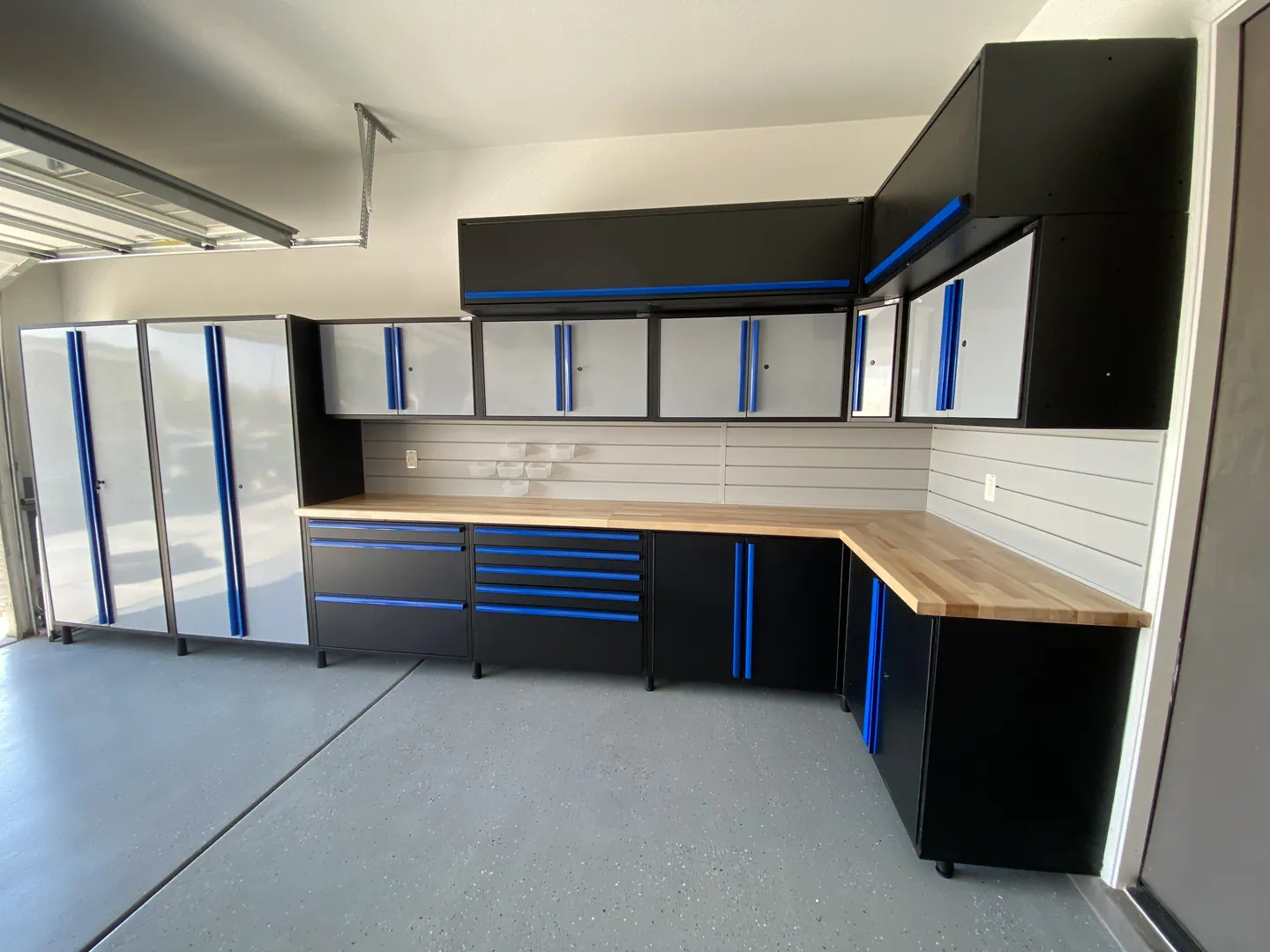
There are cabinets.
There is open shelving.
There is slatwall.
There are fixed overhead racks.
There are motorized overhead storage systems.
There are specialized ways to store large or awkward items.
Sometimes the best solution is a combination of several of those things.
And sometimes the answer is something completely different.
I’ll tell customers this all the time:
“I love selling cabinets. I make a living selling cabinets. And I will certainly put them in if that’s what you want me to do. However, in my opinion, cabinets are not your best answer for this particular situation.”
Then I explain why.
And then I listen again.
Because sometimes the conversation changes.
The homeowner may have started by asking for cabinets, but after we talk about what they’re really trying to accomplish, we discover that what they actually need is something else.
My job isn’t to convince them that my first idea is right.
My job is to help them find the solution that makes the most sense for their garage.
One Christmas Tree Almost Cost Me a Sale
I was recently in a home in Mesa where the homeowners were interested in a motorized overhead storage rack.
I love those things.
Honestly, they’re some of the coolest products we sell. People love them. They love showing them off. They love using them. And when they’re the right solution, they can make life in the garage dramatically easier.
These homeowners were a little older, and their garage was relatively small. They already had cabinets around much of the perimeter and were parking their car inside, so space was fairly tight.
As I looked around, I found a perfect location for a 4-by-8-foot Bluetooth-controlled motorized lift.
Everything seemed to line up.
So I asked what they wanted to store on it.
She told me it was for her Christmas tree.
“Your Christmas tree?” I asked.
She explained that she had purchased a really nice tree that year. It had cost around $200, and she wanted to keep it nice. But it was large, and she needed somewhere to store it.
Now, I had been pretty excited about selling her that motorized rack.
But when she told me what she wanted it for, I knew I had to tell her what I really thought.
I explained that as much as I wanted to sell her the rack, I didn’t think it made sense.
If she spent the money on that motorized storage system just to preserve a $200 Christmas tree, she could buy a brand-new tree every year for twelve years before she saved a dime compared with what she was spending to store this one.
I suggested another possibility.
Put up the nice tree.
Enjoy it.
And when Christmas is over, give it away. Give it to a charity. Give it to a neighbor. Put it on the sidewalk and sell it for twenty dollars.
Then next year, buy another beautiful tree.
No dust.
No cobwebs.
No missing pieces.
No burned-out lights.
No climbing a ladder to get it down.
She even pointed out that she might not be around for another twelve years.
I was thinking the same thing.
I just wasn’t going to say it.
We laughed about it, but the point was serious.
I talked a customer out of buying something I really wanted to sell her because I didn’t believe it was the best use of her money.
And I’m okay with that.
I’m not a perfect person. I make plenty of mistakes.
But I never want someone to say that I wasn’t fair with them.
It’s Your Garage, Not Mine
There is another side to that conversation that is just as important.
I can give you my opinion.
I can tell you what I think would work best.
I can explain why I would do something differently.
But at the end of the day, it’s not my home. It’s not my garage. And it’s not my decision.
If something is dangerous or unethical, that’s different. I won’t install something I can’t safely or ethically stand behind.
But if you’ve heard my recommendation, understand the alternatives, and still say, “Ryan, I understand what you’re saying, but this is what I want,” then that’s your choice.
My job is to give you the benefit of my experience.
Your job is to decide what is right for your home.
I think that’s an important distinction.
Having a professional opinion doesn’t mean taking away the homeowner’s ability to make the final decision.
First, Let’s Get It Off the Ground
Once I understand what the homeowner is trying to accomplish, one of the first principles I start thinking about is simple:
Get the stuff off the floor.
Walk into 99 percent of the garages I’ve seen and you’ll find the same basic situation.
Stuff is piled around the perimeter.
The floor is crowded.
And then you look up.
Where the walls meet the ceiling, it’s often completely clean and empty.
We’ve done the exact opposite of what we should be doing.
My goal is to reverse that.
Get the stuff up and out of the way so we can give the floor back to the homeowner and their vehicles.
In Arizona, many builders make a two-car garage approximately 20 feet by 20 feet.
That’s not a huge amount of space when you’re trying to fit two vehicles, open car doors, walk around them, and still have room for everything else a family owns.
You don’t have to be driving a Smart car or a Prius before you start noticing the problem.
Anything that permanently occupies floor space effectively makes the garage narrower.
I sometimes think of it as shrinking the hips of the garage.
Cabinets, floor-standing shelving, refrigerators, boxes, bins and other storage all have a footprint.
Even if those cabinets are completely empty, the footprint is still there.
That space is no longer available for your vehicle door to open.
It’s no longer available for someone to walk through.
And it’s no longer available for the things the garage was originally intended to accommodate.
If we can move those items upward and out of the way, we can reclaim that valuable floor space.
We’re not making the garage bigger.
We’re simply allowing you to use the square footage you already paid for.
Not Everything Needs to Be Easy to Reach
Of course, getting things off the floor doesn’t mean putting everything eight feet in the air.
Where something lives should have a lot to do with how often you use it.
Think about your wife’s wedding dress.
The box of keepsakes from Grandma.
That banker box of tax records from 1984.
Those things may be important.
You may absolutely want to keep them.
But how often do you actually get into them?
Probably never.
So why should they occupy some of the easiest-to-reach storage in your garage?
Put those things high and out of the way.
Then think about seasonal decorations.
Christmas.
Halloween.
Other things you pull out once a year.
Those can go up high too.
Sure, you might cuss and complain a little while you’re getting the Christmas decorations down.
But you’ve got eleven months to get over it before you have to do it again.
That’s a reasonable trade.
What I don’t want is for the things you use every day to be buried behind the things you use once a year.
The broom.
The mop.
The Swiffer.
The dog leash.
Paper towels.
Toilet paper.
Household cleaning supplies.
Car cleaning supplies.
Those are things you reach for regularly.
They should be easy to find and easy to access.
Good storage isn’t simply about where things fit.
It’s about where things make sense.
And Then There Are the Weird Things
Every garage has them.
The things that don’t fit neatly into a cabinet.
The rooftop car carrier.
The paddleboard.
The kayak.
The canoe.
The surfboard.
The Jeep or Bronco hard top.
The receiver-hitch bike carrier.
The generator.
The fifth-wheel hitch.
These are the things that remind me why I don’t believe there is one storage solution that works for every garage.
You don’t solve every storage problem by building another cabinet.
Sometimes you need to look at the object itself and ask:
“What’s the smartest way to store this particular thing?”
Maybe it belongs overhead.
Maybe it belongs on a wall.
Maybe it needs a specialized storage system.
Maybe it needs to be suspended from the ceiling.
Maybe it needs to be somewhere completely different.
The goal isn’t to make every item fit a particular product.
The goal is to find the right home for the item.
Sometimes There Is Just Too Much Stuff
Then there are the garages where storage isn’t the problem.
I once walked into a garage with a woman who wanted help “organizing” it.
There were plastic storage totes from floor to ceiling.
From wall to wall to wall.
There was a skinny little path through the middle that she used to walk into and out of the garage.
She told me she really needed help organizing everything so she could get some more room.
I had to give her some difficult news.
As nicely as I could, I told her:
“The problem isn’t a lack of organization. The problem is the amount of stuff.”
I told her she had ten pounds of stuff in a five-pound garage.
There wasn’t a shelf, cabinet, rack, or storage product on the planet that could make her garage physically larger.
Sometimes that’s the answer people don’t want to hear.
Good storage can reclaim an incredible amount of space.
But it can’t create square footage that doesn’t exist.
Sometimes the first step toward taking back your garage is deciding what actually needs to stay in it.
The Best Garage Isn’t Necessarily the Most Expensive Garage
Once we’ve figured out what the homeowner is trying to accomplish and what the garage needs, there’s one more thing I think about:
How can I accomplish all of this without wasting their money?
I know things are expensive.
I’ve been the consumer.
I’ve hired contractors.
I’ve been the guy standing on the other side of the conversation wondering how much something is going to cost.
I have five kids.
I lived on a police officer’s salary in a one-income home.
I understand that spending thousands of dollars on a garage isn’t necessarily an easy decision.
That’s one reason I don’t like throwing money at a problem just because I can.
If I can accomplish the same goal with a less expensive but more efficient product, that’s what I want to do.
The most expensive solution isn’t automatically the best solution.
The cheapest solution isn’t automatically the best solution either.
The best solution is the one that accomplishes what the homeowner needs while making the most sense for their budget.
Sometimes that means cabinets.
Sometimes it means shelving.
Sometimes it means an overhead rack.
Sometimes it means a combination.
And sometimes it means doing less.
You Don’t Have to Do Everything Today
There’s another thing I tell customers that may sound strange coming from someone trying to make a living doing this:
It doesn’t have to be a one-and-done project.
When I build a quote, I give the homeowner the options we’ve discussed. They can look at the different pieces, talk about them together, decide what they actually need right now, and decide what they can comfortably afford right now.
Maybe we talked about shelving on three walls and they decide to do one wall.
That’s okay.
Maybe six months from now they call me and say, “Ryan, we’re ready for the other two walls.”
Great.
I’ll go back.
I don’t tell people, “You should have done it all the first time, because I’m not coming back.”
Life changes.
Budgets change.
Priorities change.
Sometimes the best decision is to solve the biggest problem today and worry about the rest later.
I also don’t believe in putting pressure on someone to make a decision while I’m standing in their garage.
I’ll build the quote.
I’ll include the information.
I’ll send it to their phone or email.
Then I tell them to go talk about it.
Talk about what you need.
Talk about what you want.
Talk about what you can afford.
Decide together.
Then choose the pieces that make sense.
I want you to feel comfortable making the decision—not cornered into making it.
The Price Should Be the Price
There’s one other thing I care about as a consumer, and it has carried over into the way I do business.
I hate being told one price and then discovering a completely different number when I get to the register.
It makes me feel like I’m being swindled.
So the pricing I give customers is all-inclusive, out-the-door pricing.
Obviously, taxes are taxes, and I show those as a line item.
But aside from that, I don’t want surprise charges showing up later.
The bottom line should be the bottom line.
If you’ve trusted me enough to invite me into your home, you deserve to know what you’re actually looking at.
Take a Deep Breath
One of the things I’ve learned after walking into so many garages is that homeowners often think their garage is uniquely bad.
They’ll apologize before I even get through the door.
“Sorry about the mess.”
“You’ve probably never seen anything this bad.”
“I don’t even know where to start.”
I’ve learned something:
You’re probably not as different as you think.
Most garages have pretty much the same stuff.
Most families accumulate the same kinds of things.
Most garages have the same basic problems.
I rarely walk into a garage and see something that makes me think, “Well, I’ve never seen this before. I have no idea what we’re going to do.”
You may look at your garage and see impossible chaos.
I see another garage.
Another family.
Another collection of things that need a place to live.
So take a deep breath.
What feels impossible to you may simply be another day at work for me.
Ryan’s Bottom Line
I don’t believe my job is to walk into your garage and tell you what you need.
My job is to listen.
Then I use the experience I’ve gained from seeing hundreds of garages to help you understand your options.
Maybe cabinets are the answer.
Maybe they’re not.
Maybe you need open shelving.
Maybe you need overhead storage.
Maybe you need a place for the kayak that you’ve been tripping over for three years.
Maybe you need to get the Christmas decorations out of your everyday storage.
Maybe you need to get rid of a few things.
Maybe you need to do the whole garage.
Maybe you only need to fix one wall right now.
There isn’t one answer for every garage because there isn’t one family, one budget, or one way of living.
What I want most is for you to leave the conversation feeling informed, comfortable, and empowered.
I want you to understand that you have choices.
I want you to know that you don’t have to make a decision today.
And I want you to feel like there is hope.
Hope that you can keep the things that matter to you.
Hope that you can find a place for the things you actually use.
Hope that you can open the garage door and see a space that makes sense.
And maybe, just maybe, hope that someday you can pull both cars inside.
You don’t have to figure it all out by yourself.
Sometimes you just need someone who’s willing to listen, take a look around, and say:
“Okay. Let’s figure this out.”